Using OpenAI's ChatGPT API to Score Tickets for Taylor Swift's Eras Tour
— chatgpt, openai, nlp, twitter, mongodb — 3 min read
Introduction
Missing out on concert tickets to your favorite artist can be a frustrating experience, especially when tickets end up on the resale market at exorbitant prices. This is why when I saw that Taylor Swift tickets were going for tens of thousands of dollars, I set out to build a tool that could help me stay on top of fan-verified ticket resales and provide a better chance of securing tickets at face value.
The recent Taylor Swift (The Eras Tour) onsale is a prime example of how high-demand concerts can quickly sell out. In this blog post, I'll share my journey of creating a tool that incorporates the newly released ChatGPT API and Twitter's V2 API to enhance the functionality of the tool.
Idea & Data Flow
The idea came out of a Twitter fan account that handled resale tickets at face value. They would receive requests to sell tickets and verify the authenticity of the tickets by logging into the actual Ticketmaster account. After the tickets were verified, they would be tweeted on that account.
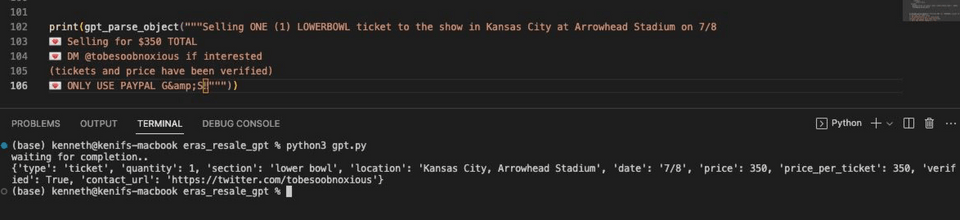
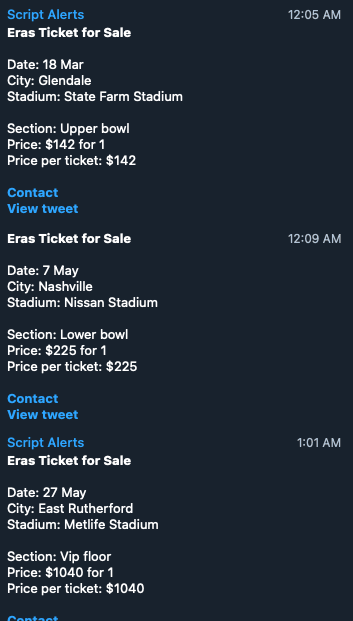
The tool automatically scrapes the Twitter account for tweets containing resale tickets, and then uses the ChatGPT API to extract relevant information such as the ticket price, number of tickets, and the venue. This information is then either actioned upon or stored in a MongoDB database for further analytics.
Parsing Listings using ChatGPT API
Notifications and Direct Messages
Conclusion
Using OpenAI's ChatGPT API, we can see how a tool can be easily created that can help secure tickets for high-demand concerts such as Taylor Swift's Eras Tour. By automating the process of finding and parsing relevant tweets, we can stay on top of ticket resales and increase their chances of securing tickets at face value.
While this application of generative AI might seem like not much of a value-add, it showcases what can be done at a fundamental level. It's when such technologies are scaled up in niche industries where we can see monumental impact.
The likes of Microsoft are even integrating such tools into their development workflow to save development time.
I'm excited to see how the space of AI advances in the near term, especially given that the scale of the largest AI computations is doubling every six months, far outpacing Moore's Law.
Till next time, stay curious!
Update (16/3/2023): Just a couple of days after writing this post, GPT-4 has been announced. It seems to have some support for vision, as well as longer inputs. Exciting to see the impact this will have in the coming months!